
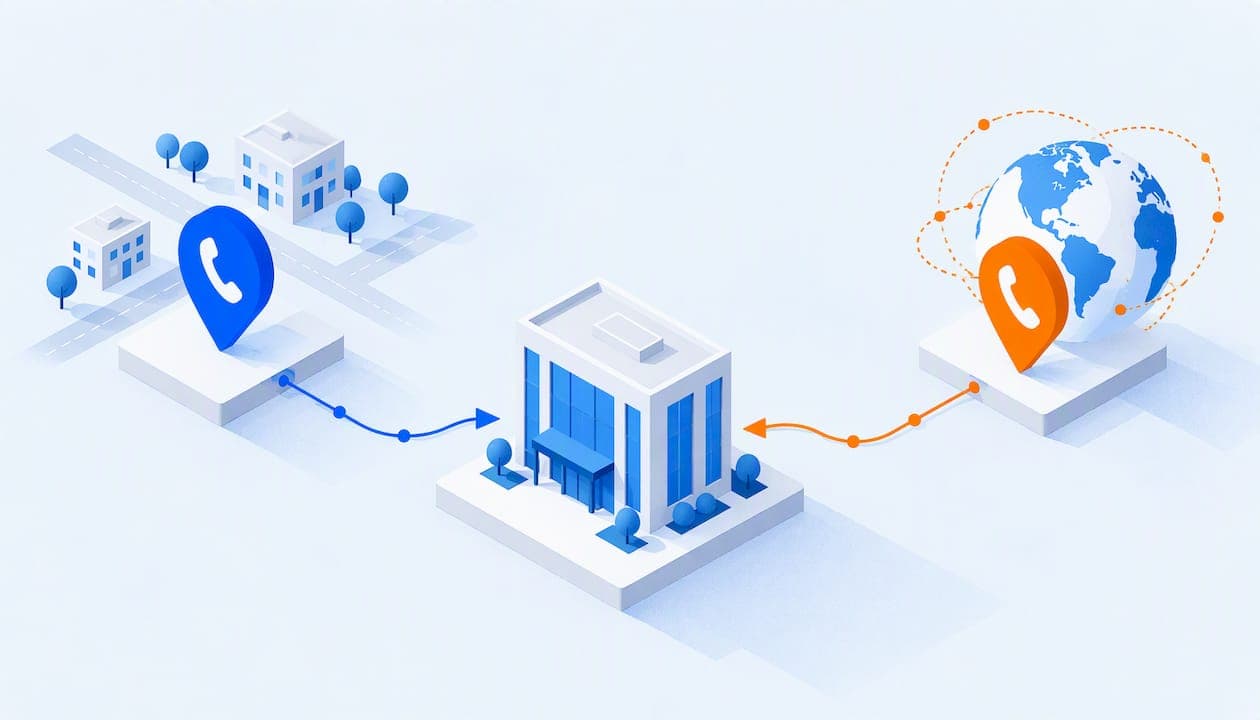
Choose a local number if most of your customers live within a few counties of you and you want to look like a neighbor. Choose a toll-free number if you serve people across the country, or if you want one number that never changes when you move or open a second location. Many small businesses end up with both, pointed at the same phone system. The prefix matters less than most guides suggest. What matters more is how calls are routed, answered and billed once they arrive.
Below we cover how the two number types differ, what "free" really means, how each one affects trust, what happens when you switch providers, and how to decide for a small business, school, nonprofit or hotel.
TL;DR
- Local numbers carry an area code and signal "we're from here." Toll-free numbers (800, 888, 877, 866, 855, 844, 833) signal reach and permanence.
- "Toll-free" means the business pays for the call. Landline callers generally aren't charged, but mobile callers may still use plan minutes.
- A local number is not automatically free for every caller, and a toll-free number is not automatically expensive for you. Your provider's pricing model decides that.
- Texting works on a toll-free number only if it is text-enabled, so verify it separately.
- Your number is a business asset. Choose a provider that lets you port it out, and keep the old service active until the move is finished.
Table of Contents
- What actually separates the two
- What "toll-free" really means for the caller
- Is a local number really cheaper for the caller?
- Is a toll-free number more expensive for you?
- When a local number wins
- When a toll-free number wins
- How each number affects trust
- You don't have to choose just one
- Porting: your number is an asset
- Texting and other details people forget
- A quick way to decide
- Our perspective: price the system, not the prefix
- What a flat-rate system looks like in practice
- FAQ
- Sources
What actually separates the two
A local number is tied to a geographic area code. A toll-free number uses a distinct three-digit code instead. According to the FCC, toll-free numbers can be dialed from landlines at no charge to the caller, which lets people reach a business outside their own area without a long-distance charge.
In the US, the toll-free codes are 800, 888, 877, 866, 855, 844 and 833. If you see a number starting with 855 and wonder whether it counts, it does. It is just as toll-free as an 800 number, and the 855 prefix is simply a newer one.
One detail trips up printed materials. The prefixes are not interchangeable. A seven-digit number dialed with 800 in front reaches a different destination than the same seven digits with 855 in front. If you print a number on signage, menus, reservation confirmations or donation forms, copy the exact prefix every time.
| Local number | Toll-free number | |
|---|---|---|
| Code | Geographic area code | 800, 888, 877, 866, 855, 844, 833 |
| Image | Neighborhood, familiar | National, established |
| Who pays the toll | Depends on caller's plan and distance | The business, on landline calls |
| Best for | Local customers, local ads, community trust | Multi-state service, hotlines, national campaigns |
| Moves with you | Tied to a region in the customer's mind | Region-neutral |
| Texting | Depends on provider | Only if text-enabled |
What "toll-free" really means for the caller
The phrase "free call" needs care. Toll-free means the called party pays the toll charge. For landline callers there is generally no charge. For wireless callers, the FCC explains that they may use airtime minutes unless their plan includes unlimited calling.
In practice, most people today are on plans with unlimited calling, so the difference is small. Still, avoid promising that every call is cost-free. A line such as "Call us toll-free" is accurate. "Calling us costs you nothing" is a promise you can't fully keep, which matters most for schools, hotels and nonprofits that serve people on limited prepaid plans.
Is a local number really cheaper for the caller?
Not always. The FCC's guide to local, local toll and long distance calling explains that a call outside the caller's local exchange can be a local-toll or long-distance call, and per-minute charges can apply unless the caller has a bundle that includes them. A local-looking number does not guarantee a free call, because carrier plans and geography both matter.
That makes an area code a branding cue, not a pricing guarantee. If you cover a wide territory, such as a contractor serving several counties or a school district spread across a region, a local number in one town may look local to some callers and not to others.
Is a toll-free number more expensive for you?
This is where small businesses get surprised. The number type alone does not set your bill. The FCC notes that VoIP providers use different models: some charge for calls outside a calling area, while others offer flat-rate calling.
So when you compare quotes, don't stop at "local" or "toll-free." Ask for the full recurring and usage-based cost:
- Monthly fee for the number itself
- Per-minute charge for inbound toll-free calls, and whether any minutes are included
- Text messaging fees, if you need SMS
- Per-user charges, which add up fast as you grow
- Hardware, setup and support
We see the same trap again and again: a low headline price, then metered usage and per-seat fees on top. For a deeper look at what a phone system should cost, see our guide to how much a business phone system costs.
When a local number wins
Pick a local number when your customers are mostly nearby and familiarity helps you close the call.
- Home services and trades. A plumber, electrician or landscaper serving one metro area benefits from an area code people recognize.
- Restaurants, salons and shops. Customers calling to book or ask about hours expect a local number.
- Local ads and listings. A number matching the area code of your map listing looks consistent.
- Outbound calling. People are more likely to pick up a call from an area code they know than from an unfamiliar number, so sales and appointment-reminder calls often go out on a local number.
- Small schools and community nonprofits. Parents and neighbors already think of you as local.
A local number also reads as personal. It says someone in town will answer, and that is a good thing when it's true.
When a toll-free number wins
Pick toll-free when your audience is spread out or the call is a service line.
- Multi-state or national service. One number works for a customer in Maine or Arizona, with no sense that you're "somewhere else."
- Customer support and hotlines. Callers expect a toll-free line for help, and it signals an established organization.
- Hotels and motels with out-of-town guests. Reservation calls come from all over. A toll-free line on your site and printed material makes booking easy, and you can keep a local number for the front desk.
- Nonprofits with donors across the country. A single toll-free number on mailers and appeals makes it easy to call, and it does not tie your identity to one town.
- Growing businesses. If you plan to add locations, a region-neutral number won't need replacing.
Some owners like toll-free numbers because they are easy to remember. Vanity formats, where digits spell something relevant, are a common branding use, and they are assigned first-come, first-served through Responsible Organizations under FCC rules.
How each number affects trust
Neither prefix proves your legitimacy. The FCC doesn't treat a number type as a trust signal, and scammers use both local and toll-free numbers. If you're a caller wondering whether to pick up an unexpected toll-free call, treat it as unverified. Don't share passwords, payment details or sensitive records, and if the caller pushes for urgent action, hang up and contact the organization through its official website or a number from a statement you already have.
For your business, this shapes how you present yourself. Customers trust the pattern more than the prefix:
- A professional greeting with your business name
- Correct caller ID on outbound calls
- A real person or a clear menu, not a dead end
- Consistency between your website, listings and signage
Those are controls inside the phone system, which is why spam call protection, call screening and a documented escalation path do more for trust than choosing one prefix over the other.
You don't have to choose just one
Most cloud phone systems let several numbers ring into the same system. A typical small-business setup looks like this:
- A local number for your storefront, listings and local ads
- A toll-free number on your website, mailers and invoices for customers farther away
- Both routed through one auto-attendant, with ring groups or call queues sending each call to the right people
- Voicemail-to-email, so a message left after hours reaches you wherever you are
Because the system does the routing, callers never know or care that two numbers lead to the same place. The decision stops being either/or and becomes a question of which front doors you want open.
Example: a three-room inn
An inn takes reservations from travelers across several states and also answers calls from local suppliers. It publishes a toll-free number for bookings and keeps its local number for vendors and neighbors. Both ring the front desk first, then roll to a mobile app after hours. One system, two numbers, no extra staff.

Example: a regional nonprofit
A food bank serving two counties uses a local number on flyers at the community center and a toll-free number in its statewide donation mailer. Volunteers answer from a ring group, and unanswered calls go to voicemail-to-email.
Porting: your number is an asset
Whatever you pick, treat the number as something you own, not something your provider owns. FCC rules require toll-free portability when a subscriber changes providers, as the FCC's toll-free number overview explains. In practice, that means you can move it. It also means paperwork.
If you want to move a toll-free or local number to a new phone system, work through this checklist:
- Keep the old service active. Don't cancel until the number has fully moved. Losing the number mid-move is a bigger risk than choosing the wrong prefix.
- Gather account details. You will typically need the account owner's name, billing address, account number and authorization from the person on file.
- Confirm the exact number and prefix. Check it against your printed materials.
- Ask the new provider to handle the request. Toll-free numbers change control through a Responsible Organization rather than moving like a local number, so the new provider needs to support it.
- Plan the cutover. Schedule it for a quiet period, and set up routing, greetings and voicemail on the new system first.
- Test from landline and mobile. Call the number from both and confirm it rings where you expect.
If your current provider's contract is the obstacle, ask your new provider whether they will walk you through the paperwork. We can tell you what we need before you cancel anything.
Texting and other details people forget
Customers experience your number through voice, text, routing and support, not through the prefix. Two points are easy to miss:
- SMS. Customers can text a toll-free number only if it is text-enabled. Don't assume it. If parents, guests, donors or customers need to text you, put text enablement and message handling on your provider checklist.
- Mobile and desktop access. Staff who work away from the desk should be able to answer both numbers from an app, with the business number shown on outbound calls instead of a personal cell number.
Our list of the top 10 features every small business VoIP system should have covers the rest of what to check.
A quick way to decide
Answer these four questions:
- Where do 80% of your callers live? If it's within one metro area, start local. If they're spread out, add toll-free.
- Who calls whom? Mostly inbound support or reservations leans toward toll-free. Mostly outbound sales or reminders leans local.
- Will you grow or move? If yes, a toll-free number won't need replacing when you relocate.
- What does your provider charge for inbound toll-free usage? If the answer is unclear, get it in writing before you print anything.
If you're still stuck, use both. Keep your local number, add toll-free where reach matters, and route everything into one system.
Our perspective: price the system, not the prefix
We build flat-rate phone systems for small businesses, non-profits, schools and hotels, and the number question comes up constantly. Our view is simple: the prefix is the smaller decision. The bigger one is whether your phone system charges you more every time you add a person, a number or a feature.

Most providers bill per user each month. That model makes a second line, a seasonal hire or a new front desk feel expensive, and it quietly pushes owners to cut corners, such as sharing one login or skipping the call queue. We charge one rate regardless of how many people use the system, with features like call recording, conferencing, auto-attendants, call queues, ring groups, voicemail-to-email and spam call protection included. Setup is free, there are no contracts, and a real person answers support, around the clock.
For numbers, that means you can think about customers first. Where do they live? How do they want to reach you? Then build the call flow around the answer. If you're considering a toll-free line, ask us about it before you print anything, and we'll tell you what's involved for your situation.
— User
What a flat-rate system looks like in practice
Our Business plan is from $125 per month, with unlimited users and no per-user fees. If you work from home, the Home Office plan is $25 per month. Hotels and motels can see hotel phone system pricing, which starts at $125 per month per property. We also supply pre-configured Grandstream desk and cordless phones and analog adapters if you have older equipment, listed on our features page.
If you're comparing providers more broadly, our guide to choosing VoIP for a small business lays out the questions to ask and the pitfalls to avoid.
FAQ
What's the difference between a regular number and a toll-free number?
A regular number carries a geographic area code, while a toll-free number uses a code such as 800 or 855. Landline callers generally aren't charged to reach a toll-free number, because the business pays. A regular number can cost a caller more if the call falls outside their local calling area and their plan doesn't cover it.
Can I call a toll-free number from my mobile phone?
Yes. The FCC says wireless callers may still use airtime minutes unless their plan includes unlimited calling. Most current plans include unlimited calling, so many callers never notice. If your audience may be on limited plans, avoid wording that promises a completely free call.
Is 855 a toll-free number?
Yes. The FCC lists 855 among the seven US toll-free codes, along with 800, 888, 877, 866, 844 and 833. Keep in mind that 855 and 800 followed by the same seven digits are different numbers, so print the exact prefix.
Should I answer a toll-free call?
The prefix alone doesn't tell you whether a call is legitimate. If you don't recognize the number, let it go to voicemail, and never give out passwords, payment information or sensitive records to an unexpected caller. If someone claims to be from a company, look up its number on its official website and call back.
Can I move my existing number to a new phone system?
Usually, yes. FCC rules require toll-free portability when you change providers, and local numbers can move too. Keep your current service active until the move is complete, and gather your account details first so the request goes through smoothly.
Sources
- FCC: What Is a Toll-Free Number and How Does It Work?
- FCC: Local, Local Toll, and Long Distance Calling
- FCC: Consumer Guide, Voice Over Internet Protocol (VoIP)
- FCC: What is a Toll-Free Number and How Does it Work (PDF)