
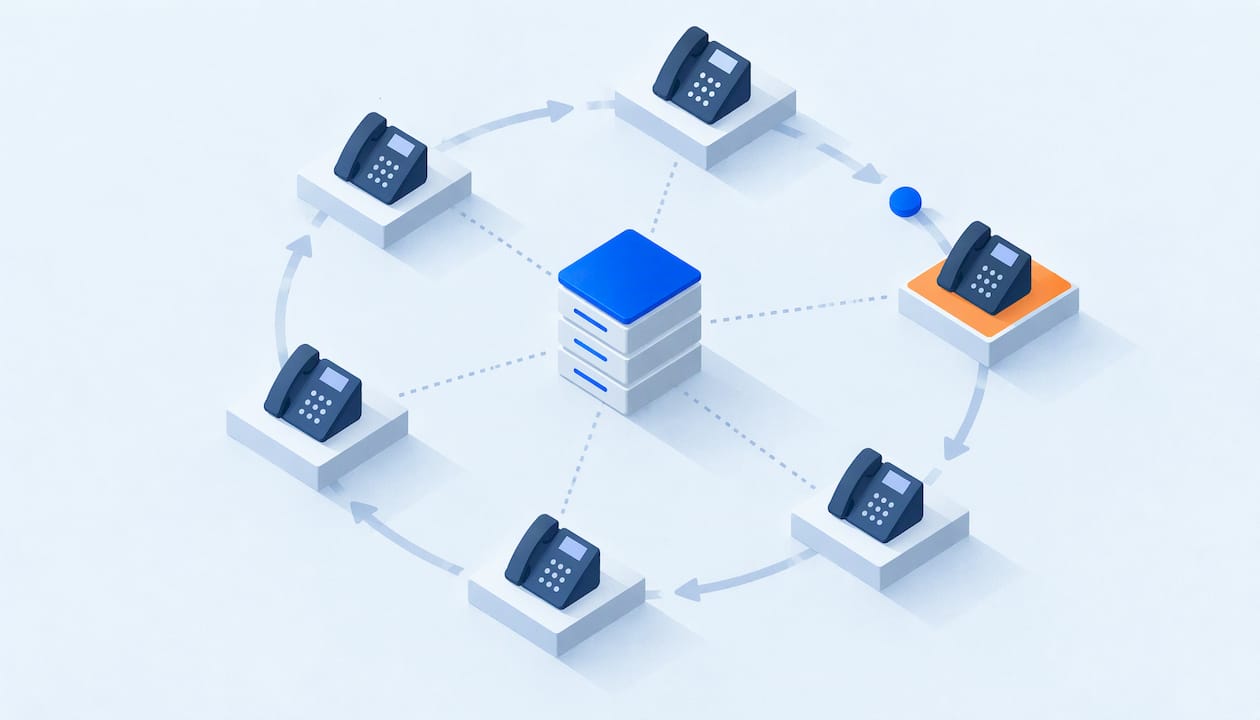
Round robin routing sends each new call, lead or request to the next person or server in a fixed rotation, then starts over at the top of the list. Agent A gets the first call, B the second, C the third, and the fourth goes back to A. In a business phone system it spreads inbound calls evenly across a team. In networking it spreads traffic across servers. This guide covers both meanings, with the most space on phone calls, because that is where small businesses use it.
TL;DR
- Round robin routing hands each new call to the next person in a repeating order, so everyone gets a similar share of the workload.
- It works best when your team is of similar skill and your calls take about the same time to handle.
- It works less well when calls vary a lot in length, when some staff are more experienced, or when you want the same caller to reach the same person.
- Other common strategies are simultaneous ringing, linear (hunt) order, longest idle and skills-based routing. Many small businesses combine two.
- With a flat-rate phone system you can add people to a rotation without paying per user.
Table of Contents
- What round robin routing means
- How round robin call routing works
- Round robin vs. other call routing strategies
- When round robin is the right choice
- When round robin is not the best fit
- How to set up a round robin call group, step by step
- Round robin in load balancing and lead routing
- Common mistakes with round robin routing
- Our perspective
- What to look for in a phone system that supports routing
- Flat-rate phone systems for rotating teams
- FAQ
- Sources
What round robin routing means
The name comes from taking turns. Round robin is a long-standing scheduling idea in computing: a scheduler gives each process in a queue a turn, then moves on to the next one, and cycles back when it reaches the end of the list. Wikipedia's entry on round-robin scheduling describes it as one of the algorithms used by process and network schedulers.
The same logic shows up in three places you are likely to run into:
- Call routing. Inbound calls are assigned to agents or extensions in turn.
- Lead and ticket assignment. New leads or support tickets are assigned to reps in a repeating order.
- Load balancing. Requests are sent to a pool of servers one after another, often using DNS.
If you landed here from an IT angle, the principle is identical across all three. The only difference is what is being handed out: a phone call, a record or a web request. The rest of this article focuses on phone calls.
How round robin call routing works
A round robin call group has three parts: a number (or menu option) that callers dial, a list of people in the group, and a pointer that remembers who got the last call.
Here is a simple example with four people on a front-desk team: Maria, Devon, Priya and Sam.
- Call 1 rings Maria.
- Call 2 rings Devon.
- Call 3 rings Priya.
- Call 4 rings Sam.
- Call 5 goes back to Maria.
The pointer moves forward after every call, whether the call was answered or not. Most systems also include a fallback. If the person whose turn it is does not pick up within a set number of rings, the call moves to the next person. If nobody answers, it goes to voicemail, a different group, or a mobile number.
Two details matter in practice:
- What counts as a turn. Some systems advance the pointer when a call is offered, others only when it is answered. This changes how fair the split feels if people miss calls.
- What happens to unavailable people. A good setup skips anyone who is on a call, in do-not-disturb mode or logged out, rather than ringing a busy phone.
Round robin vs. other call routing strategies
Round robin is one option among several. The right pick depends on how your calls arrive and who answers them.
| Strategy | How it works | Best for | Watch out for |
|---|---|---|---|
| Round robin | Each call goes to the next person in a repeating order | Teams of similar skill who should share calls evenly | Uneven call lengths can leave one person buried |
| Simultaneous (ring all) | Every phone rings at once, first to answer takes it | Small teams, owners who want the fastest pickup | Can feel chaotic with many people ringing |
| Linear (hunt order) | Always starts at person 1, then 2, then 3 | A primary contact with backups | Person 1 gets most of the calls |
| Longest idle | Call goes to whoever has gone longest without a call | Busy teams that want fairness based on actual activity | Needs call status tracking |
| Skills-based | Call goes to the person best matched to the need | Sales, billing and support lines with different specialties | Needs a menu or caller data to pick the right skill |
| Time-based | Routes change by hour, day or holiday | Businesses with set hours or an after-hours answering person | Schedules need regular updating |
Round robin and longest idle are close cousins. Round robin follows a fixed order. Longest idle follows real activity. If one person spends twenty minutes on a long call, a pure rotation still sends them the next turn when it comes around, while a longest-idle method would skip them. If your calls vary a lot in length, ask whether your system can skip agents who are on a call. That one setting closes most of the gap between the two methods.
When round robin is the right choice
Round robin fits best when three things are true: the people answering are interchangeable, the calls are similar in effort, and fairness matters to your team.

Front desks and reception teams. A medical office, dental practice or property office where any staff member can handle a general inquiry. Rotation keeps one person from being stuck with every call.
Sales teams with shared leads. When a new inquiry comes in, the next rep in line takes it. Reps see the process as fair, and leads are followed up promptly because each one has a clear owner.
Hotel and motel desks. Calls to a property's main number can rotate between front desk staff across a shift. If you run a property, our guide on VoIP for hotels and hospitality covers how a modern phone system handles guest rooms, front desk and back office together.
Non-profits and volunteer lines. A helpline or donor line staffed by several part-timers or volunteers can share calls without anyone being singled out. Our piece on VoIP for non-profit organizations goes into budget and setup considerations.
School offices. An attendance line or main office can rotate calls between administrative staff during busy mornings.
When round robin is not the best fit
Round robin is simple, and simplicity has limits. These are the situations where another strategy, or a combination, usually serves callers better.
- Specialists on the team. If billing questions need one person and technical questions need another, a menu with separate groups works better. Use an auto-attendant to send callers to the right group, then use round robin inside each group.
- Existing customers who want their own contact. Routing a repeat caller to the same person is a different goal. Pair your routing with caller ID matching or a direct extension.
- Very small teams. With two or three people, ringing everyone at once is often faster and feels more natural.
- Large gaps in availability. If half the group works part-time, a rotation can send calls to people who are not at their desk. Use schedules or mobile apps so the rotation only includes people who are working.
How to set up a round robin call group, step by step
The screens differ from one phone system to another, but the planning is the same.
- List who is in the group. Write down names and extensions. Keep the group focused: one team, one purpose.
- Pick the order. Alphabetical is fine. If one person is a new hire, you can place them where they will get the first call at a quieter time of day.
- Set the ring time per person. Fifteen to twenty seconds is a common starting point, which is about four to five rings. Shorter times move calls along faster, but may not give people time to reach the phone.
- Choose a fallback. Decide where unanswered calls go: another group, a cell phone, or voicemail with a clear message. Voicemail-to-email makes sure nothing is missed.
- Add a greeting. A professional greeting tells callers they are in the right place and sets expectations.
- Make it work on every device. Staff should be able to answer from a desk phone, desktop app or mobile app, so remote and on-the-go team members stay in the rotation.
- Review after two weeks. Check how many calls each person took, how many went unanswered and how long callers waited. Adjust ring time and membership from there.
If you want a second opinion on the wider phone setup around your routing, the overview of managed VoIP with fixed fees covers how small businesses think about the infrastructure behind call handling.
Round robin in load balancing and lead routing
The same keyword brings up pages about web servers and CRMs, so here is the short version of how round robin works in those contexts.
Server load balancing. A load balancer sends request one to server one, request two to server two, and so on. It is easy to run and works well when servers are alike and requests are similar. If servers differ in capacity, a weighted version gives bigger servers a larger share of the turns. Where a user needs to stay on the same server for a whole session, a sticky method is used on top.
Lead routing in a CRM. New leads go to the next rep in the rotation. Sales managers use it to avoid cherry-picking and to speed up response times. Add rules for territory, product line or rep availability when needed.
Phone calls. This is the same idea, applied to a live conversation, where timing matters most. A caller waits in real time, so the choice of who rings, and for how long, directly affects how your business sounds.
Common mistakes with round robin routing
- Ringing people who are away. Without presence or schedule awareness, calls go to empty desks. Use apps and schedules so the rotation reflects who is working.
- Forgetting about breaks and lunches. Plan for coverage gaps, or have staff step out of the rotation briefly.
- Making the group too big. Large groups mean long waits when the first few people do not answer. Split by function and keep each rotation to a handful of people.
- Skipping the fallback. A call that rings through the whole list and ends in silence loses a customer. Always set a final destination.
- Never reviewing results. Calls change with the season. A rotation that worked in January may not work in the holiday rush.
Our perspective
Most small businesses we talk to do not need a complicated call center setup. They need calls to reach a real person, quickly, without one employee carrying the whole load. Round robin is often the cleanest way to get there.
The catch is that many phone providers make you pay for every person you add to a group. That pushes owners to keep rotations small or leave part-timers out, which defeats the point of sharing the work. We built our pricing the other way around: one flat rate, unlimited users, and the features included. Adding a seasonal hire or a volunteer to a ring group does not change your bill.
We also think routing should not be something you have to figure out alone. Our team handles custom configuration and managed PBX setup, and setup is included at no charge. Tell us how your calls should flow, who answers, when and what happens when nobody does, and we build it. Changes are handled the same day, and you reach a real person 24/7 if something needs adjusting.
Start simple. Pick one group, set a sensible fallback, watch the numbers for two weeks and adjust. Good routing is rarely clever. It is consistent.
Preston
What to look for in a phone system that supports routing
Whichever strategy you choose, the system underneath decides how well it works. Use this checklist when you compare providers.
- Ring groups and call queues that let you decide how calls are distributed.
- Auto-attendant menus that send callers to the right group before routing begins.
- Voicemail-to-email so a missed call becomes a message you can act on.
- Mobile and desktop apps so staff can answer from anywhere and stay in the rotation.
- Call recording to review how calls were handled and coach your team.
- Pricing that does not penalize growth. Per-user fees make every added team member a new line item.
- Real human support. When a routing rule needs to change on a busy day, you want a person, not a ticket queue.
- Hardware options. Pre-configured desk phones, cordless phones and analog adapters for legacy equipment let you keep what you have and add what you need.
For teams that are comparing hosted options, the 3CX unified communications overview shows another way businesses approach a managed phone system.
Flat-rate phone systems for rotating teams
Rotation works best when everyone who should answer calls can be in the group. That is why per-user pricing and round robin fit so badly together. Every person you add to the rotation adds a monthly charge, so owners cut people out to control cost.
PJL Telecom takes a different approach. Our Business plan starts at $125 per month, and our Home Office plan is $25 per month. There are no per-user fees, and features such as call recording, conferencing, auto-attendants, voicemail-to-email, call queues and ring groups are included. There are no contracts, and setup is free.

Running a property? Our Hotel Phone Systems and Motel Phone Systems start at $125 per month per property. Pre-configured Grandstream desk and cordless phones, along with analog adapters for existing equipment, are available on our features page. You can also see how we work with schools and non-profits at pjltelecom.com.
FAQ
What is round robin with an example?
Round robin means giving each person or server a turn in a fixed order, then starting again at the beginning. If a team has three reps and five calls arrive, the calls go to rep 1, 2, 3, 1, 2. Over time, everyone gets a nearly equal number of calls.
What does round robin distribution mean for phone calls?
It means inbound calls are shared across a group in a repeating order instead of always ringing the same person first. The goal is a fair split of the workload. It also keeps one employee from becoming the default for every caller.
Is round robin the same as longest idle routing?
No. Round robin follows a fixed order, while longest idle sends the next call to whoever has gone the longest without one. Longest idle adapts better when calls vary in length. Round robin is easier to understand and predict, which suits small teams with steady call volume.
Which call routing strategy is best for a small business?
For a team of two or three, ringing everyone at once is usually simplest. As the team grows, round robin or a similar rotation spreads calls more fairly. Many businesses add an auto-attendant first so callers reach the right group, then use rotation inside each group.
Can I use round robin if my team works remotely?
Yes, as long as your phone system lets staff answer on a mobile or desktop app. The rotation then includes anyone who is logged in, wherever they are. Set schedules so people who are off for the day are left out.