
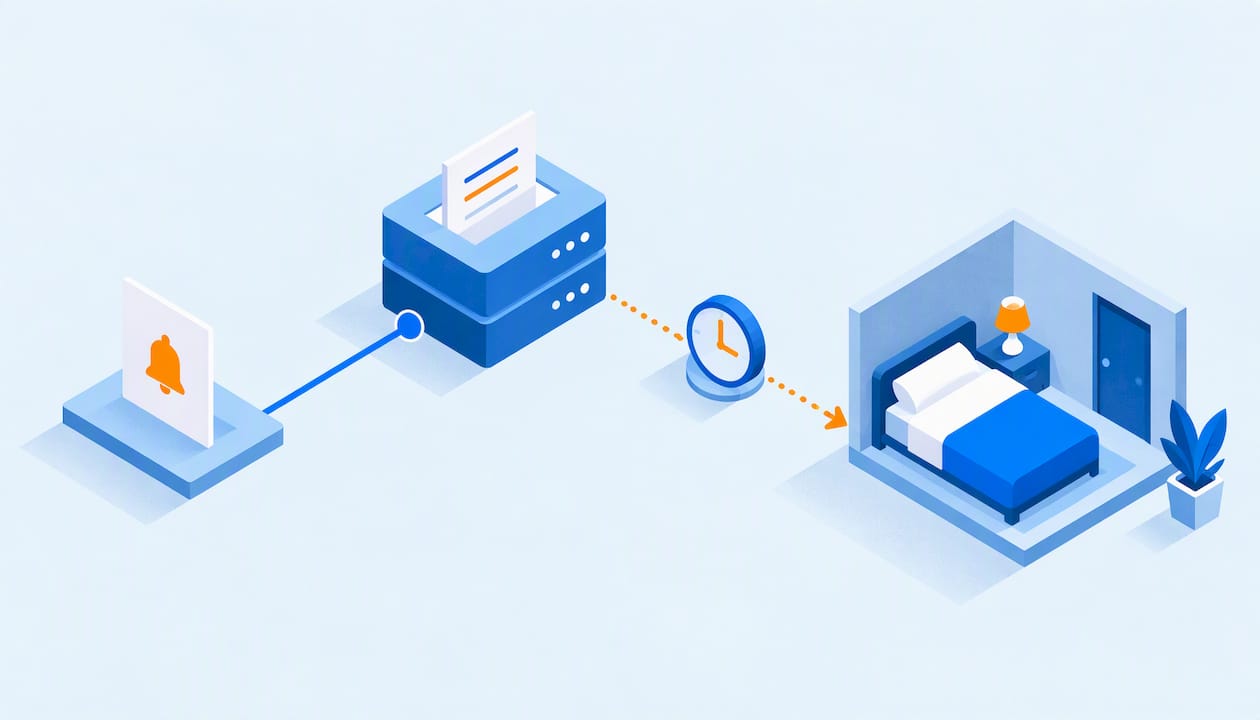
A hotel wake-up call is a phone call to a guest's room at a time the guest picks. The guest asks for it at the front desk or on the room phone, and either a staff member or an automated system places the call. For guests, it is a backup to a phone alarm. For hotel owners, it is a small service with real liability attached, and it only works when the phone system behind it is set up properly.
This guide covers both sides: how a guest gets a call that actually arrives, and what a hotel or motel needs from its phone system to deliver every one on time.
TL;DR
- Guests request a wake-up call by dialing 0 for the front desk or by using a wake-up button or keypad on the room phone, then confirming the time and AM or PM.
- Automated systems store the request and place the call at the scheduled time. Many integrate with the property management system (PMS), so staff do not enter times by hand.
- Unanswered calls need a defined routine: a second call, then a knock on the door, plus a record of every call requested and placed.
- Cloud phone systems for hotels are often priced per room. We charge a flat rate per property instead, starting at $125 per month.
Table of Contents
- How a guest requests a wake-up call
- Manual and automated wake-up calls
- How an automated wake-up system works
- What to do when a wake-up call is missed
- What your phone system needs for reliable wake-up calls
- What a hotel phone system costs
- Our perspective: flat rate, no per-room math
- Hotel phone systems built for your property
- Wake-up calls beyond hotels
- Tips for guests who want a call that works
- FAQ
- Sources
How a guest requests a wake-up call
The process is simple, and the mistakes are almost always in the details.
- Pick up the room phone. Guests typically dial 0 to reach the front desk or PBX operator, or press a dedicated wake-up button on the phone in hotels with an automated system, according to a hospitality law firm's guide to wake-up call standards.
- State the time clearly. Say "6:30 AM" rather than "6:30." The AM or PM confusion is the most common way a call gets set for the wrong half of the day.
- Ask for a read-back. If a person takes the request, have them repeat the time and room number. If the phone has a keypad menu, wait for the confirmation prompt.
- Answer the call. Many automated systems play a recorded message and then hang up. Others ring a set number of times and retry. Do not let it ring out and assume the system will keep trying.
- Keep a backup. For a flight or an important meeting, set a phone alarm as well. A call and an alarm fail for different reasons, so using both is safer than either.
If the room has no phone, or the phone is in an unusual place, ask the front desk what they can do. Some hotels will send a staff member or call a mobile number instead.
Manual and automated wake-up calls
There are two ways a hotel can deliver the call, and many properties run both.
Manual calls. A front desk agent writes down the request and phones the room at the time. This costs nothing in software, and staff can add a personal touch, such as asking if the guest wants a taxi or breakfast sent up. The weak points are human: a missed note at shift change, a busy lobby at 6 AM, a wrong room number.
The same hospitality law guide notes that automated systems remove labor costs and reduce human error, but lack the personal follow-up a staff member can offer, such as taking a room-service breakfast order.
Automated calls. The guest or the front desk enters the time once. The system stores it and dials the room on schedule, plays a message, and logs the result. At a property with dozens or hundreds of rooms, this matters most between roughly 5 AM and 8 AM, when many guests ask for calls in the same few minutes. A system that places calls in parallel and retries the unanswered ones handles that peak without pulling a clerk away from checkouts.
| Manual | Automated | |
|---|---|---|
| Setup | None | Phone system feature, sometimes PMS link |
| Staff time at peak | High | Low |
| Risk of lost request | Handwritten notes, shift handoffs | Stored request, scheduled call |
| Personal touch | Yes | Recorded message only |
| Record of calls | Only if staff keep one | Usually a report or log |
| Best for | Very small properties | Any property with more than a handful of rooms |
How an automated wake-up system works
Under the hood, an automated system has three jobs: take the request, store it, and place the call.
In a PMS-connected setup, the request often starts in the PMS. Oracle's documentation for its OPERA Cloud system says that when a wake-up call is set, the instructions go straight to the property's PBX, which stores them and places the call at the requested time. The PMS then tracks the status. A call moves from Pending to Completed once the order is sent to the PBX, and a placed call that nobody picked up can be marked No Answer. A wake-up call report can be generated afterward.
In a room-phone setup, guests enter their desired time on the keypad and the system calls the room at that time, as described in the same hospitality law guide.
Two practical points follow from this:
- The phone system has to place the calls. The PMS holds the schedule, but the PBX or cloud phone system rings the room. If the phone side cannot handle many outbound calls to extensions at once, the 6:30 AM peak is where you find out.
- "PMS compatible" is not the same as integrated. One hotel software vendor advises checking feature-by-feature integration with your PMS instead of trusting a general compatibility label, since the label can mean a generic middleware layer that needs separate licensing and support. Ask directly: can a wake-up call set in my PMS or booking record be scheduled and delivered by this phone system?
What to do when a wake-up call is missed
A missed call is a service failure, and when the guest misses a flight or a meeting, it can become a complaint or a claim. A written routine helps staff and protects the property.
The hospitality law guide recommends this sequence:
- If the call goes unanswered, place a second call right away.
- If it is still unanswered, a staff member knocks on the door and announces the wake-up call.
- Keep records of calls requested and placed.
That guide also advises keeping those records for a minimum of 60 days to reduce legal liability, particularly if a guest misses a critical appointment or flight. Check your own retention policy and insurance requirements with your attorney or insurer, since this is guidance rather than a universal rule.
Two habits prevent most misses:
- Confirm AM or PM at request time. Staff should repeat it back, and the system's confirmation message should say it.
- Review the morning report. At the start of the day shift, check which calls were marked No Answer. A guest who did not answer may still be asleep.
What your phone system needs for reliable wake-up calls
Whether you run a 12-room motel or a 200-room hotel, use this checklist when you evaluate a phone system.
- Scheduled calls to every guest room extension. Test it. Request calls for several rooms at the same minute and see if they all ring.
- Retry logic. The system should try again on no answer, and the log should show the result.
- A report you can print or export. You need it for your records and for any dispute.
- A front desk way to enter, change and cancel calls. Fast changes matter when a guest extends a stay or catches an earlier flight.
- A real person to call when it fails. A system that misfires at 5 AM needs support that is awake.
- 911 compliance. Hotel phone systems in the United States must support direct 911 dialing and dispatchable room-level locations under Kari's Law and the RAY BAUM'S Act, per a 2026 hotel phone buyer's guide. Wake-up features are nice, but this one is a legal requirement.
- Analog compatibility. Many older properties still have analog room phones. An adapter lets them connect to a cloud system without rewiring the building.
For a deeper look at how to choose a provider, see our guide to hotel phone systems and VoIP providers.
What a hotel phone system costs
Pricing is where hotel owners most often get surprised. The same buyer's guide puts cloud-hosted PBX systems for hotels at roughly $5 to $15 per guest room per month, with administrative staff seats at $10 to $35 per user per month. It also puts on-premise PBX installation at $15,000 to $40,000 or more upfront. These are market ranges from one vendor's guide for 2026, not quotes, so treat them as a way to sanity-check any proposal.
The per-room math shows why the pricing model matters. At $10 per room per month, a 60-room hotel pays $600 per month before any staff seats. A motel that adds rooms or a hotel that adds a wing sees the bill rise with every phone.

Our perspective: flat rate, no per-room math
We built our hotel service around one idea: your phone bill should not grow every time your property does. Most phone providers charge per user or per room, and the extras (call recording, conferencing, queues) arrive as add-ons. We charge one flat rate per property, with all features included.
Here is what that looks like for wake-up calls and the rest of the guest phone experience:
- Flat pricing by property. Our hotel and motel plans start at $125 per month per property. That is the price whether you have 20 rooms or 200. Current details are on our hotel phone systems page and our motel phone systems page.
- Real people at any hour. Wake-up problems happen early in the morning, and hotels run all night. We provide 24/7 real human support, and system changes and support calls are handled the same day.
- Setup included, no contracts. We configure the system with you, and setup is free.
- Hardware that fits the building. We resell pre-configured Grandstream desk and cordless phones, and analog adapters for legacy room phones, so you do not have to replace everything at once.
- Monitoring. Our team watches the network proactively, so a problem is more likely to be caught before guests notice it.
Our honest advice is to pick the system by how well it handles your busiest morning, not by the feature list. Ask for a test with real rooms, and ask who answers the phone when it does not work.
— User
Hotel phone systems built for your property
If you run a hotel or motel and want guest-room phones, front desk lines, an auto-attendant and reliable 911 support under one flat rate, we can set it up for you. Plans for properties start at $125 per month, with no per-room or per-user fees.
See our managed phone systems for hospitality for guest room and staff phones, or review the hotel phone system plans. If you want to see how a flat rate compares for your size, our pricing page lays it out, and we do not require a contract.
Wake-up calls beyond hotels
The same idea, a scheduled call or alert to a person at a set time, shows up in other places. Schools use scheduled bells and announcements, and some campuses send desktop alerts to selected computers, as one safety vendor describes for universities, K-12 districts and certain nonprofits. Dormitories, hospitals, shelters and retreat centers have a similar need for timed calls to individual rooms.
What these settings share with hotels is the need for ring groups, scheduled calling and clear records. A flat-rate cloud system with unlimited users scales to these cases without a per-extension fee, which is why we serve schools and non-profits as well as hotels.
Tips for guests who want a call that works
- Request the call at check-in, not at midnight when the desk is busy.
- Say the room number, the time and AM or PM, and ask for confirmation.
- Keep the room phone off do-not-disturb, and check that the ringer is on.
- Know how to answer. Some phones need you to lift the handset and wait for the message.
- Set a phone alarm too. If the call is for something you cannot miss, you want two independent methods.
- If the call does not come, tell the front desk afterward. It helps the hotel fix a gap.
FAQ
How do I request a hotel wake-up call?
Dial 0 for the front desk, or use a wake-up button or keypad menu on the room phone if it has one. State the time and confirm AM or PM. If the phone has a menu, wait for the confirmation message before you hang up.
Do hotels still offer wake-up calls?
Yes, many do, especially full-service hotels, and a large share now use automated systems. Smaller properties may take requests at the desk. If the room has no usable phone, ask what the hotel can do instead.
What happens if I do not answer a wake-up call?
A well-run hotel places a second call right away. If that goes unanswered, staff knock on the door and announce the call. The hotel should also log the result, for example as No Answer in its system.
Can an automated system call many rooms at once?
Yes, if the phone system is built for it. The PMS stores the schedule and the PBX or cloud phone places the calls at the requested times. Test the busiest morning window with several rooms before you rely on it, and confirm the PMS-to-phone integration works feature by feature.
How much does a hotel wake-up call system cost?
It depends on how the phone system is priced. A 2026 buyer's guide puts cloud PBX at roughly $5 to $15 per room per month, while we charge a flat rate per property starting at $125 per month, with wake-up scheduling handled as part of the phone system setup.
Sources
- Wake-up call standards: "I'd like to leave a wake-up call for high noon"
- Oracle OPERA Cloud: Managing Wake Up Calls
- Hotel Phone System: Complete Buyer's Guide 2026
- Alertus: Free Desktop Alerting