
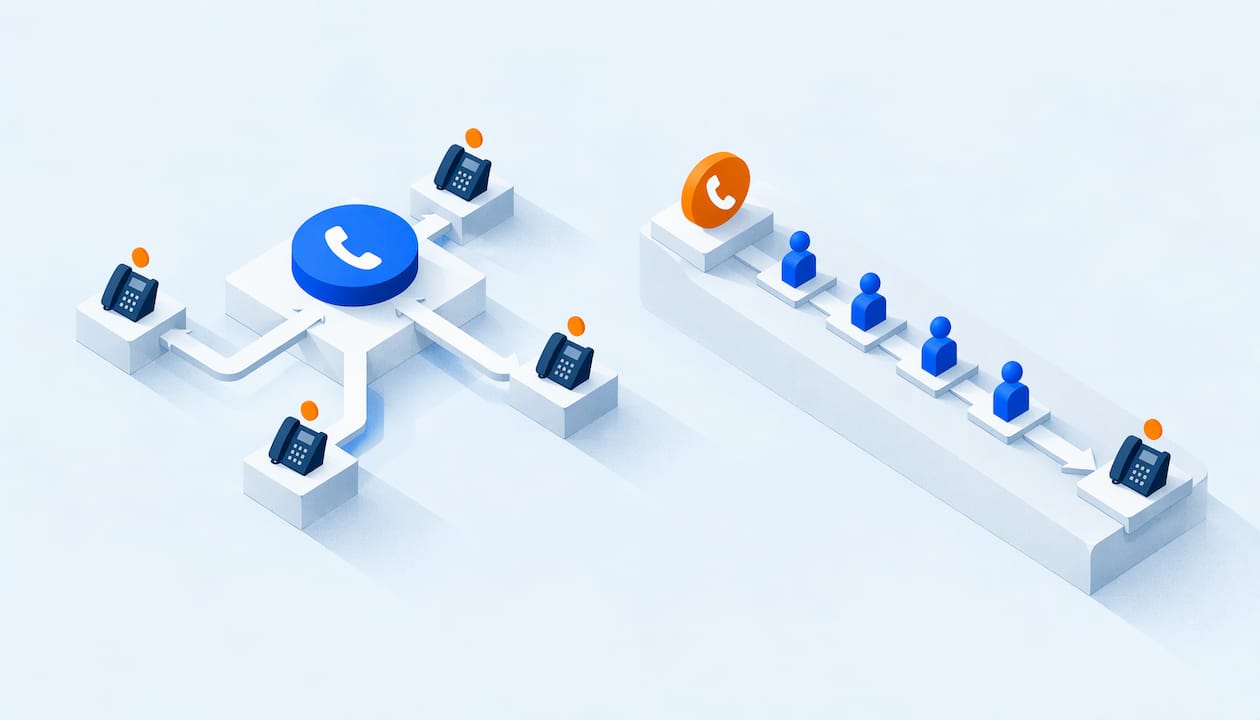
A ring group rings several phones at once or in a set order, so someone picks up. A call queue holds callers in line, with music or announcements, until a team member is free. Use a ring group when a small team can usually answer right away. Use a call queue when more calls can arrive than people can answer. A hunt group is an older name for the same idea as a ring group.
That is the whole decision for most small businesses, nonprofits, schools and hotels. The rest of this article shows how each one behaves, where each goes wrong, and how to set up both without paying extra for either. At PJL Telecom, call queues and ring groups come with a flat-rate plan, so you can use the one that fits each phone number.
TL;DR
- Ring group: one number, several phones. Calls ring everyone at once or one after another. Best for small teams where someone is nearly always free.
- Call queue: callers wait in line, hear hold music or messages, and are connected in order. Best when calls can pile up.
- Hunt group: the traditional PBX name for a ring group, usually for sequential ringing. Vendors use the label differently, so read what the feature does, not what it is called.
- Real test: ask what a caller experiences when everyone is busy. If the answer is "they should not wait," you need a queue.
- Cost: on a flat-rate plan with unlimited users, adding people to a group does not add a per-user fee.
Table of Contents
- What a ring group does
- What a call queue does
- Call queue vs ring group side by side
- Where hunt groups fit
- What happens when nobody answers
- Which one fits your organization
- How to choose in four questions
- Common mistakes
- The pricing question
- Our perspective
- Set up both on a flat-rate plan
- FAQ
- Sources
What a ring group does
A ring group is a set of extensions tied to one number or menu option. When someone dials that number, the system rings the members' phones. The first person to answer takes the call and the others stop ringing.
There are three common ways a ring group rings:
- Ring all: every phone rings together. This is the fastest way to get a live answer from a small team.
- Sequential (in order): the system rings the first person, then the second, then the third. It suits cases where one person should be the first choice, such as an owner who wants the front desk to try first.
- Rotating: the starting person changes with each call, which spreads calls more evenly across the group.
A ring group has no real concept of waiting. If nobody answers, the call moves on to its fallback: voicemail, another group, a mobile number or a greeting. The caller hears ringing, not a line-up.
That makes ring groups simple, predictable and easy to explain to staff. They are also the right tool for a lot of small-office situations. A three-person dental office, a church office or a small property manager rarely has five callers at once, and a ring group makes sure none of the three phones is the only one that can answer.
What a call queue does
A call queue is a waiting line for callers. When every member is busy, new callers stay in the line, hearing hold music or announcements while they wait, and the system connects them in the order they arrived as team members free up.
The features that make a queue different from a ring group are all about the wait:
- Order of service. First in, first out, so no caller is skipped.
- Wait messages. A short "thanks for holding, someone will be with you shortly" tells callers they have not been dropped.
- Overflow or timeout rules. After a set time, the call can go to voicemail, another team or a mobile number, so nobody waits forever.
- Member availability. Team members can usually be set as available or unavailable, so calls go to people who are actually at their desks.
If you are thinking about wait messages, overflow and handling several callers at once as part of a wider customer experience, this overview of customer service automation for small businesses covers the follow-up side after the call is answered.
The tradeoff is that a queue is a bigger promise. A caller who waits in line expects to be served. A queue with too few people behind it just moves frustration from the ringing stage to the hold stage, so it has to be staffed for the call volume it receives.
Call queue vs ring group side by side
| Ring group | Call queue | |
|---|---|---|
| What the caller hears | Ringing | Ringing, then hold music or messages |
| When all members are busy | Call goes to the fallback (voicemail, another number) | Caller waits in line |
| Order | Everyone at once, in a set order, or rotating | First in, first out |
| Best for | Small teams, front desks, owner plus assistant | Busier lines: support, reservations, billing, main office lines |
| Staffing | Works with two or three people | Works best with a team that can absorb peaks |
| Main risk | Missed calls when everyone is busy | Long waits if the team is too small |
| Complexity | Very low | Low to moderate |
Where hunt groups fit
Search results for these terms mix the names up, so here is the plain version. "Hunt group" comes from traditional office phone systems, where the switch "hunted" down a list of lines for a free one. "Ring group" is the term most cloud systems use now.
In practice:
- A hunt group and a ring group both send calls to a set of phones, with no waiting line.
- Some systems use "hunt group" only for strictly sequential ringing and "ring group" for ringing everyone at once, but there is no industry-wide rule.
- A call queue is a different feature because it holds callers in line.
So "hunt group vs call queue" is the same question as "ring group vs call queue," and the answer is the same. If you are reading a quote or a feature list and see both words, read the description of what the feature does.
What happens when nobody answers
This is where the two features really separate, so decide it before you set anything up.
In a ring group, the call rings for a set number of seconds. After that, you choose where it goes. Common choices are a shared voicemail box, voicemail sent to email, a second group, or a manager's mobile phone.
In a call queue, the call stays in line. You choose how long it can wait, what the caller hears, and what happens when the limit is reached. The same fallback options apply: voicemail, another team or a mobile number.

Whichever you use, give every group a fallback that ends with a person or a message that gets read. A voicemail box nobody checks is the most common way groups lose calls. Voicemail that arrives as an email is far harder to miss, and an email to a shared mailbox means anyone on the team can pick it up.
Which one fits your organization
Small business and home office
If you have two to six people and calls come in one or two at a time, start with a ring group. It is simple and quick to set up, and it gets callers to a live voice. If your phone rings hard at certain times (after a promotion, at month end, at lunch), put a queue on the main line so callers wait in order instead of hearing voicemail.
A common mix: a ring group for the front desk and a queue for a busy sales or service line.
Nonprofits
Nonprofit teams are often lean, and staff may be in the office one day and at an event the next. A ring group that includes staff mobile apps means a call can reach someone wherever they are. A queue helps around campaigns, appeals or event registrations, when many supporters call at once and a few staff handle them. A short wait message that names the cause ("you've reached our registration line") keeps callers patient.
Schools
School front offices see predictable peaks: morning attendance calls, dismissal changes, enrollment season. A queue on the main number or an attendance line handles those peaks fairly. Ring groups work well for departments such as the nurse's office, facilities, transportation or IT, where one of several people should answer. Because a school's staff list changes each year, a plan with unlimited users makes it easy to add or remove members without watching a per-seat bill.
Hotels and motels
A front desk needs the fastest answer possible, which is a ring group that rings the desk phone, the cordless phone and the manager's app together. Evenings and check-in times can produce overlapping calls, so a queue on the main number keeps guests in order when the desk is busy with someone in person. Guest room calls to the desk are a natural fit for a ring group so the call is answered by whichever staff member is nearest. For properties that want a phone setup built around rooms, see our hotel phone systems and guest room and staff phones.

Whatever you choose, your hotel or office phone system also has to meet the federal 911 rules. The FCC's rules implementing Kari's Law require multi-line telephone systems to support direct dialing of 911, without a prefix or access code, and to notify someone on site when a 911 call is made. E911 compliance is part of what we provide.
How to choose in four questions
- How many calls arrive at the same time? If rarely more than one, a ring group is enough. If two or three at once is normal, you need a queue.
- Is a live answer worth a wait? If your callers would rather leave a message than hold, use a ring group with voicemail. If they need a person (reservations, billing, urgent requests), use a queue.
- Who is the team? Two or three people work as a ring group. Four or more, with schedules that change, suit a queue where people can mark themselves available or unavailable.
- Where do people work? If staff move between desk, home and mobile, check that the group can include apps and mobile numbers, not just desk phones.
You can also combine them. A main number can go to an auto-attendant ("press 1 for sales, 2 for support"), where sales is a ring group and support is a queue. That is a common setup for a small organization that wants to sound organized without a receptionist.
Common mistakes
- Using a queue for a team of one or two. Callers wait in line while the one person is on another call. A ring group with a good voicemail is usually better.
- Ringing everyone for every call. In a large ring group, ringing every phone creates noise and confusion. Use rotating or sequential ringing, or move to a queue.
- No fallback. Every group needs an end point. A call that rings forever or lands in an unchecked mailbox is a lost customer.
- Forgetting schedule changes. Holidays, summer hours, staff leave and school breaks all change who should be in each group. Review membership each season.
- Letting a group name hide the setup. "Support" and "Office" mean nothing to the system. Name groups by what they do and review them when staff change.
The pricing question
On many phone systems, every person you add to a group is another monthly seat, and features like queues or call recording show up as add-ons. That can make routing decisions a budget decision, so owners end up putting fewer people into a group than the callers need.
Our plans are built the other way. Pricing is a single flat rate regardless of how many people are on the system, and call queues, ring groups, auto-attendants and voicemail-to-email are included with no per-user fees. You can set groups up the way your callers need instead of the way a seat count allows.
Our perspective
We set up phone systems for small organizations, and the most useful advice we can give about routing is to start from the caller. Ask what the person on the other end needs: a quick answer, a particular person, or a fair place in line.
A ring group answers the first need well and a queue answers the third. Most small organizations end up with both, a ring group for the people who share a desk or a role, and a queue for the line that gets busy.
Where a lot of owners get stuck is the cost. If each extra person on a group is another monthly fee, you hold back on adding people, and the callers are the ones who feel it. That is why we use a flat rate with unlimited users and include these features. Setup is free, changes are handled the same day, and real people answer our support line around the clock, so you can adjust a group when your team or call volume changes.
If you are not sure which fits, describe how your phones ring on a normal Tuesday and a bad Monday. That usually settles it.
Preston
Set up both on a flat-rate plan
Our Business plan starts at $125 per month, and our Home Office plan is $25 per month. Both are flat-rate, with unlimited users on the Business plan and no per-user fees, and with call queues, ring groups, auto-attendants, voicemail-to-email, call recording and conferencing included. We configure the system to your setup, there are no contracts, and setup is free. Hotels and motels start at $125 per month per property.

See the Business and Home Office plans, or the motel phone systems page if you run a smaller property. Our support article on ring groups and call queues goes through the settings in more detail. Pre-configured Grandstream desk and cordless phones are available on our features page if you want hardware that arrives ready to use.
FAQ
Is a ring group the same as a hunt group?
In most cases, yes. Hunt group is the older, traditional-PBX name and ring group is the term most cloud systems use. Some vendors use hunt group only for ringing in a fixed order, so check what the feature does rather than relying on the name.
Can I use a ring group and a call queue together?
Yes, and many organizations do. For example, an auto-attendant can send "sales" to a ring group and "support" to a queue. You can also make a ring group the overflow for a queue, or a queue the fallback for a ring group that is often busy.
How many people should be in a ring group?
For ringing everyone at once, a small number works best, often two to five people. Past that, many phones ring at once and nobody knows who is taking the call. For larger groups, use rotating or sequential ringing or move to a queue.
Do callers in a queue hear anything while they wait?
Usually yes. Callers typically hear hold music or recorded messages, and you can set them to tell the caller that they are in line. Keeping the message short and friendly helps callers stay on the line.
Does a queue cost more than a ring group?
That depends on the plan. On a flat-rate plan like ours, both are included, so you choose based on how your callers behave and not on what the feature costs.